
Which side should the wine bottle face when pouring wine?
Regular readers of our Wine Blog know well that etiquette is a universe rich in details that are often unknown to most people or simply underestimated in everyday life. In reality, every gesture, even the simplest one, has its own precise logic and follows rules that help make the wine experience more harmonious, elegant, and mindful.
Among these details, one of the most overlooked yet actually fundamental aspects concerns the position and orientation of the bottle during service: which side should the bottle face when pouring wine?
It may seem like a secondary detail, almost a triviality for those who are not used to observing wine service closely. Yet, within the context of wine etiquette, it is anything but marginal. On the contrary, it is precisely one of those elements that help define the overall quality of the service.

Which side should the wine bottle be held when serving wine?
To answer this question, it is necessary to consider a key element in the presentation and service of the bottle: the label.
Therefore, the question can be more precisely rephrased as: where should the wine bottle label face when pouring wine?
More specifically, the issue concerns the orientation of the bottle during service: should the label face upwards or downwards?
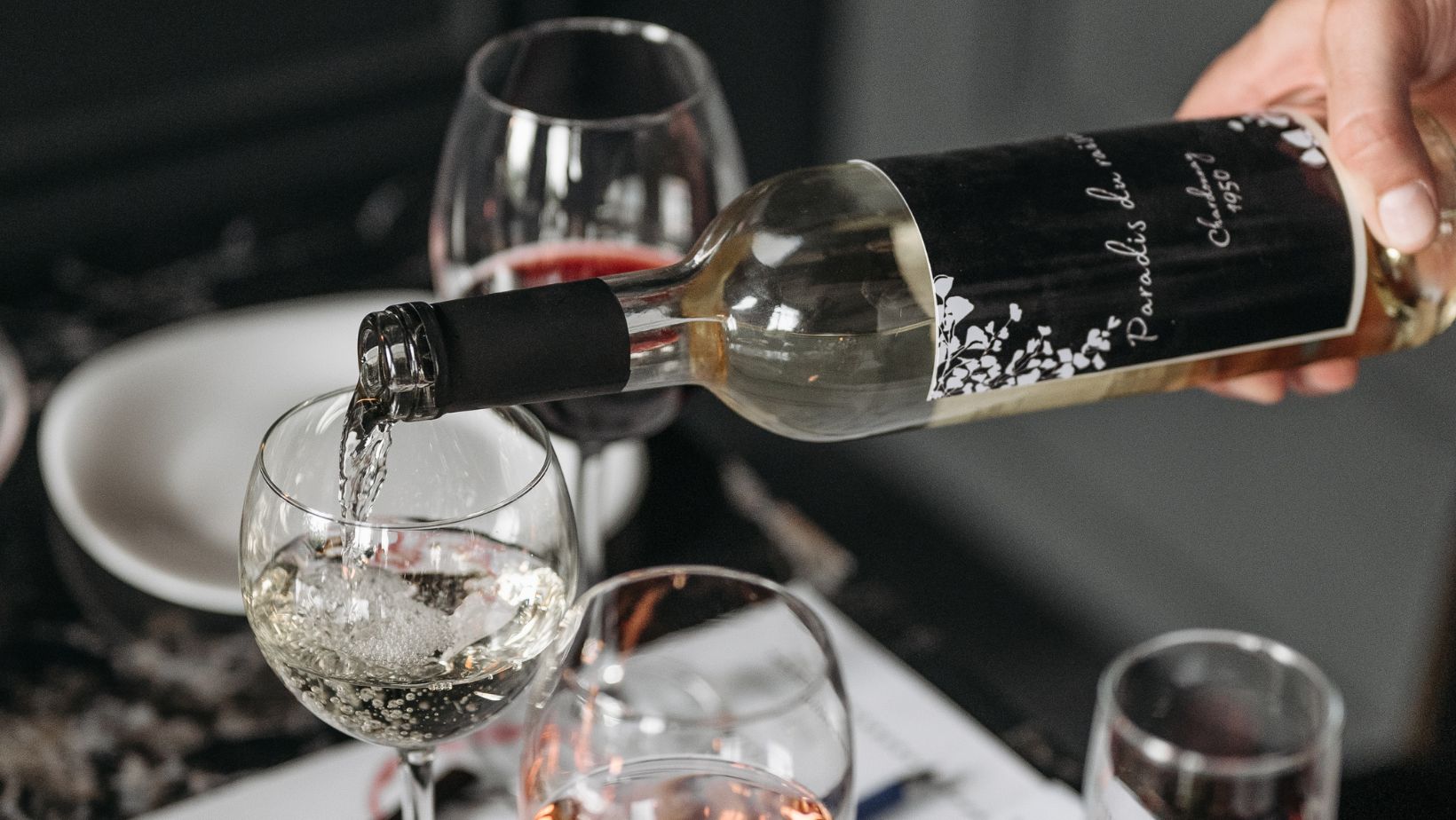
The correct serving rule is very simple and clearly defined in wine etiquette: the bottle should always be held in such a way that its front side, meaning the label, faces the guests or the table, remaining clearly visible throughout the entire pouring process.
In other words, the person serving the wine must ensure that the label is not hidden, but instead facing upwards and not covered by the hand (the photo above best illustrates these principles).
This involves some fundamental best practices:
• the bottle should be held from the lower part or the base, avoiding central grips that would cover the label;
• the palm of the hand should never cover the label;
• the bottle should already be correctly oriented before starting to pour.
In essence, according to wine etiquette, whoever serves the wine should never hide the label, but instead highlight it as an integral part of the experience.
Why should the wine bottle be held with the label facing the person receiving the wine?
In wine service, showing the label is not a simple aesthetic detail, but a true rule of communication, transparency, and service etiquette. The label, in fact, represents the identity of the bottle, and therefore it should remain clearly visible to the guest or diners at every stage of the service.
When pouring wine while keeping the label visible, several benefits are achieved:
• the bottle being served can be immediately identified, without doubt or uncertainty;
• the choice of wine is enhanced, making the gesture more mindful and refined;
• guests are able to read the winery, vintage, and type of wine;
• a greater sense of shared experience is encouraged.
The key point is that this principle, the constant visibility of the label, which characterizes the initial presentation of the bottle, does not end in that moment, but must be maintained throughout the entire service, including while pouring. It is precisely this continuity that distinguishes a careful and mindful service from one that is rushed or not fully refined.
Keeping the label visible even while pouring wine means ensuring consistency and maintaining active communication with the guests. If, during pouring, the bottle is casually rotated or covered by the hand, this visual communication is interrupted and that sense of transparency, one of the foundations of elegant wine service, is lost.
On the contrary, keeping the label consistently facing upwards allows you to:
• maintain continuity in the presentation even during pouring;
• make the gesture more harmonious, orderly, and visually pleasant;
• communicate attention, care, and respect towards those at the table.
It should also be considered that, in wine etiquette, service is never purely a technical action, but a true moment of interaction. The way wine is poured contributes to the overall atmosphere of the table and to the perception of the experience.
In this context, even the visible label plays an important role: it is not a mere formal detail, but an element that makes the experience more complete and simply better. Seeing the label while the wine is being served allows guests to feel involved, to recognize what they are drinking, and to perceive a more mindful and refined service.
If you liked our article and if you want to continue to receive news, updates and curiosities about the world of wine, subscribe to the Wineshop.it wine newsletter. Lots of content and offers await you!


 Loading...